Compare AI Vendor SLA Terms for Security
Enterprise AI procurement has stopped being a curiosity line item. Global corporate spend on AI software, infrastructure, and services now clears the hundred-billion-dollar threshold annually, and…
# Evaluating AI Vendor SLAs: Security Clauses and Compliance Standards for Enterprise Buyers
Enterprise AI procurement has stopped being a curiosity line item. Global corporate spend on AI software, infrastructure, and services now clears the hundred-billion-dollar threshold annually, and individual contracts at large enterprises routinely run seven figures per year. At that scale, the Service Level Agreement is no longer a legal appendix to be skimmed by procurement. It is the document that determines who absorbs the loss when a model leaks training data, when an inference endpoint gets jailbroken, or when a regulator opens an inquiry. Get the SLA wrong, and the CFO eventually signs the cheque for someone else's breach.
The irony is that most enterprise buyers still review these contracts like cloud procurement documents from 2015. They are not. The risk surface has shifted, the vendor leverage has reorganised, and the standard clauses — uptime percentages, blanket indemnification limits, "commercially reasonable efforts" — were written for a different category of failure. Below is what actually matters when an AI vendor hands you a security SLA, and where the negotiation leverage sits between the CFO, the CISO, and the vendor's own cap table.
Beyond Uptime: Why the AI SLA Needs Different Numbers
For two decades, the corporate SLA revolved around availability. 99.9% uptime translated to roughly 8.7 hours of acceptable annual downtime. 99.99% shrank that to about 52 minutes. The framework was built for a specific failure mode: a server, a cluster, an entire region going dark.
AI deployments fail differently. The endpoint stays up. The model keeps responding. But the data is bleeding, the inference is hallucinating regulated content, or the training pipeline was poisoned three weeks ago and nobody noticed. Old uptime metrics measure availability. They do not measure confidentiality, integrity, or the latency between breach and detection.
The 99.9% uptime guarantee means nothing if the 0.1% is a six-hour exfiltration window on your customer database.
This is the first translation to make for the board. A four-hour security incident at a regulated enterprise — healthcare, financial services, anything touching personal data — averages well into seven figures once you tally forensics, notification, regulatory exposure, and the discount rate applied to lost customer trust. The "three nines" allowance, which used to mean a stalled checkout flow, now buys you a single breach event. The math does not work.
When reviewing an AI SLA, demand that availability metrics be paired with security-specific service levels. These should not live in the same paragraph as uptime. They belong in a separate schedule with separate remedies, separate credits, and a separate termination trigger. Conflating them is how procurement teams sign contracts that technically meet the SLA while completely failing the business.
Data Governance: The Training Opt-Out Is the Whole Ballgame
The single highest-leverage clause in any enterprise AI contract is not about uptime. It is the data usage clause — specifically, whether customer inputs, prompts, and fine-tuning data are absorbed into the vendor's foundation model for future training.
Most enterprise-grade AI vendors offer an opt-out. Most default contracts do not apply it. The delta between an opt-in and an opt-out can be the difference between your proprietary prompts surfacing in a competitor's chatbot and a defensible IP perimeter that holds up in litigation. Treat the default as adversarial until the contract says otherwise.
Three things to lock down in this section:
1. Zero-retention on inputs. Prompts, completions, and uploaded documents must not be persisted beyond what is technically required to return the response. Anything longer becomes a discoverable artifact in litigation and a regulated data set under most privacy regimes.
2. No training without explicit written consent. "Legitimate interest" arguments from the vendor are not acceptable for enterprise deals. If the vendor wants the data, they pay for it — through a separate research agreement with separate governance, separate compensation, and a documented data destruction timeline at the end of the study.
3. Customer-owned model artefacts. Any fine-tuned model, embedding index, or retrieval corpus built on customer data must be customer IP, returned in portable format on termination. Otherwise the switching cost calc goes vertical and the vendor's renewal pricing has nowhere to go but up.
A secondary issue hides inside this clause: data residency. If your workloads touch EU personal data, the SLA must specify the processing region and the legal basis for any cross-border transfer. Post-Schrems II, this is non-negotiable. The default of "global infrastructure" is no longer a contract term — it is a regulatory liability waiting for a regulator with bandwidth.
Compliance Frameworks: SOC 2 Is the Floor, ISO 42001 Is the Ceiling
The compliance section of an AI SLA is where vendors love to bury the buyer. They will present a SOC 2 Type II report as if it were a bond rating. It is not.
SOC 2 Type II verifies that specific security controls — defined by the vendor, audited by a third party — operated effectively over a six to twelve-month observation window. It is a snapshot of operational hygiene. It does not test the controls themselves for adequacy. A vendor can be SOC 2 compliant and still ship a fundamentally insecure AI deployment if the controls being audited are the wrong ones for the risk profile of the workload.
What enterprise buyers should demand in addition:
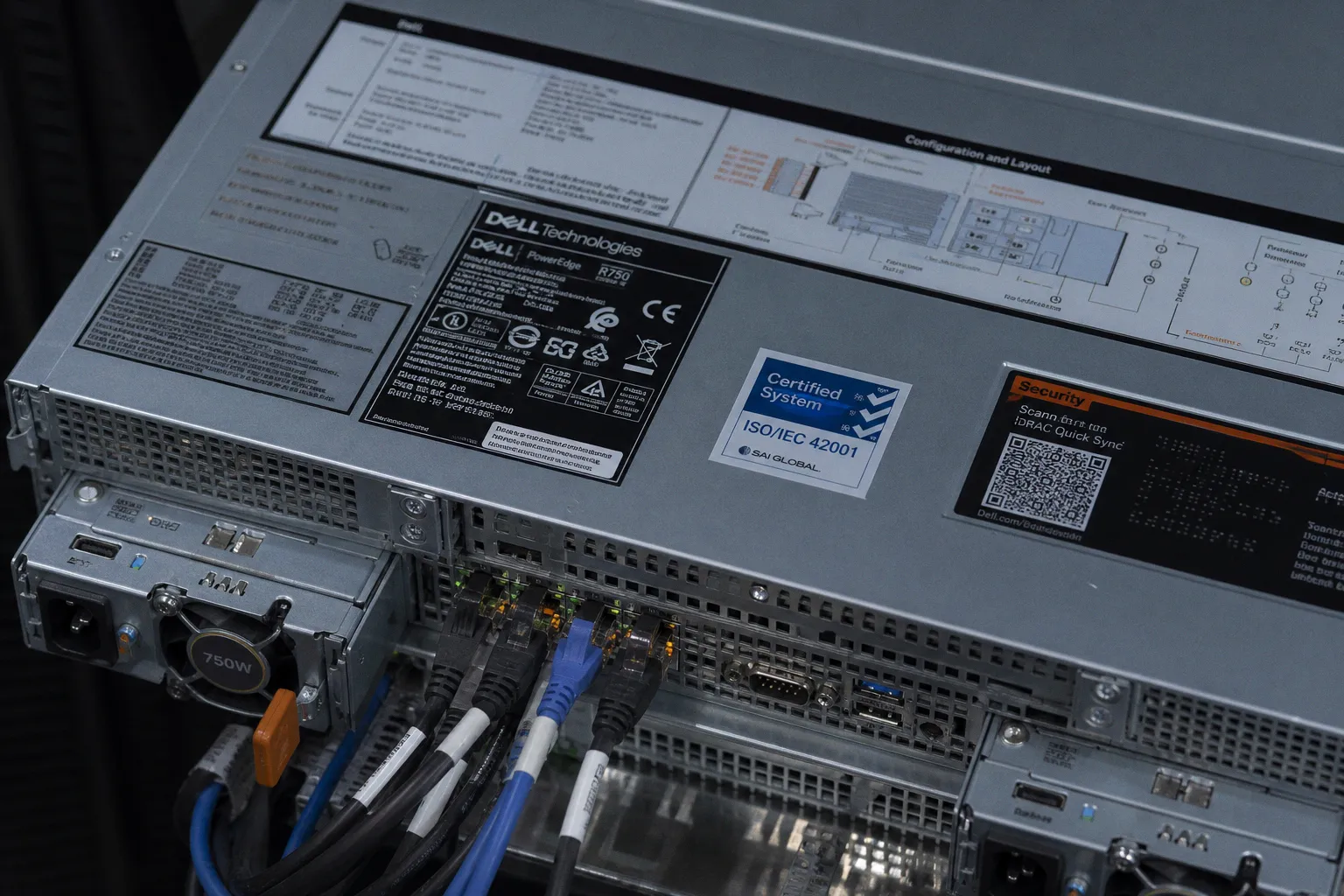
- ISO/IEC 42001 certification. Published in 2023, this is the first international standard specifically for AI Management Systems. It provides a framework for managing AI-specific risks — model drift, bias, training data provenance, third-party model dependencies. A vendor without 42001 is selling 2018 governance in a 2025 product.
- Annual penetration testing with executive-level disclosure. Not a marketing summary. The actual scope, the actual findings, and the actual remediation timeline, delivered under NDA to the customer's security team.
- Subprocessor list with notification rights. Your vendor's vendor list is functionally your vendor list. If your AI provider runs inference on a hyperscaler and that hyperscaler has an incident, you are downstream. The SLA must give you the right to receive notice and, in material cases, to terminate without penalty.
SOC 2 is what the vendor's lawyer hands you to end the conversation. ISO 42001 is what your CISO asks for when the conversation actually starts.
The insurance market has already priced the difference. Cyber underwriters now request ISO 42001 attestation as a prerequisite for premium quotes on AI-related coverage. Vendors without it are not uninsurable, but their buyers carry a larger retention layer and a thinner recovery path.
Incident Response: MTTA and MTTR Need Teeth
The SLA section on security incidents is where vague language does the most damage. Vendors love "promptly." Lawyers love "without undue delay." Neither term survives contact with a regulator, an insurer, or a plaintiff.
What the SLA must specify, in numbers:
- Mean Time to Acknowledge (MTTA). The maximum delay between incident detection and customer notification. For enterprise AI, this should be no more than 24 hours for confirmed security events, and immediate — under four hours — for any incident involving confirmed customer data exposure.
- Mean Time to Resolve (MTTR). A defined target, with tiered severity levels, and financial credits for missing it. The credits should not be capped at 10% of monthly fees — that is a rounding error against breach cost. The credits should be sized against the documented cost of the incident category.
- Forensic cooperation obligations. The vendor commits to preserving logs, providing chain-of-custody documentation, and cooperating with the customer's external incident response firm. Without this clause, post-breach discovery becomes a separate negotiation conducted under maximum duress.
Industry-standard MTTA and MTTR figures for AI security incidents do not yet exist — they vary by vendor, by deployment risk profile, and by data class. Treat that ambiguity as leverage, not as a gap. The buyer who insists on specific numbers will get specific numbers. The buyer who accepts "industry standard" will get whatever the vendor's internal standard happens to be, which is usually whatever their on-call rotation can hit.
Liability Caps: The 12-Month Lookback Is a Joke
Standard enterprise SaaS contracts cap vendor liability at fees paid in the trailing 12 months. For a $500K annual AI contract, that is $500K of cap. For a high-risk AI deployment — autonomous decisioning in healthcare, credit, employment, critical infrastructure — the potential liability is orders of magnitude above that number.
The 12-month lookback is a vendor-friendly default that migrated from CRM and email contracts without being recalibrated for the risk profile of foundation-model deployments. It works when the failure mode is "service unavailable for six hours." It does not work when the failure mode is "model produced biased lending decisions against a protected class for fourteen months before detection."
What the buyer should negotiate:
| Risk allocation mechanism | Standard SaaS default | Enterprise AI deployment |
|---|---|---|
| Liability cap | 12 months of fees | Multiple of fees OR specific dollar floor for security and data incidents |
| Cap exclusions | None — cap is total | Exclude security incidents, IP infringement, regulatory fines from the cap |
| Indemnification scope | Limited to vendor IP | Extend to model outputs, training data provenance, third-party model components |
| Insurance requirements | Generic cyber liability | Specific AI-related coverage, named additional insured, certificate delivery |
The cap structure on security and data incidents is where the negotiation is won or lost. If the vendor refuses to lift the cap for these categories, the buyer has two options: reduce the deployment scope materially, or self-insure through a captive. Neither is a comfortable answer for the CFO, which is exactly why the negotiation belongs in procurement, not in legal review after signature.
A liability cap that equals one year of fees is not risk allocation. It is risk transference to the customer dressed up as a contract term.
Following the Money: Who Carries the Risk
Every clause in the SLA is a bet on who absorbs which risk, priced into the vendor's gross margin and ultimately into their burn rate.
A vendor offering 99.99% uptime with a generous MTTA commitment and a lifted liability cap for security incidents is not being generous. They have priced the probability and the exposure. If their offering is materially better than the market, they have either superior security infrastructure or a smaller customer base they cannot afford to lose. The first is bullish. The second is a credit risk masquerading as a service level.
Conversely, a vendor offering 99.9% uptime, vague MTTA language, and a hard 12-month cap is signalling one of three things: immature security operations, a thin balance sheet that cannot absorb large incidents, or both. Either way, the buyer is effectively self-insuring against the long tail. Procurement needs to know which it is before signature, not after the first incident report.
This is where vendor financial health becomes a procurement input, not a curiosity. AI startups with aggressive burn rates and tight contracts are structurally incentivised to litigate claims rather than pay them. Series B and Series C vendors in particular tend to push back hardest on cap removal because their D&O insurance does not cover customer-facing liability at scale. By the time the company reaches maturity — or exits via acquisition — the cap is typically locked in through change-of-control provisions that survive the transaction.
For buyers evaluating newer procurement channels and emerging vendor onboarding structures, the same due diligence framework applies. A vendor's security maturity does not change because they raised capital through an unusual instrument. The SLA review remains identical regardless of the funding mechanism.
Where the Buyer Has Leverage
Three sources of leverage still exist in this market, despite vendor consolidation:
1. Multi-year commitments. Vendors will trade cap structure for committed annual spend. A three-year commitment with annual escalators buys the buyer real movement on liability and MTTA — usually enough to recover the discount through avoided incident cost.
2. Audit rights. Most enterprise vendors will grant security audit rights if asked. The clause usually costs them nothing and gives the buyer forensic access if things go wrong. A vendor that refuses audit rights is signalling something the SLA cannot hide.
3. Exit portability. The single most underpriced clause in enterprise AI contracts is the data and model portability obligation on termination. If the vendor cannot return your fine-tuned weights, your embedding indices, and your prompt logs in a portable format within 30 days, your switching cost is a hostage scenario. Build the escape into the SLA at signing, not at renewal.
The Sobering Reality Check
AI vendor SLAs are improving. They are also being written faster than the legal frameworks around them, and the case law on AI-specific liability is still embryonic. Every clause reviewed above is enforceable in principle. In practice, enforcement against a vendor that has burned through its capital and sits in default means a long, expensive fight with a thin recovery.
The pragmatic position: treat the SLA not as the boundary of vendor obligation but as the floor of your own due diligence. Insure what the cap does not cover. Audit what the SOC 2 does not test. Negotiate the MTTA as if you will actually exercise it. And price the deployment against the assumption that, on a three-year horizon, the vendor will be acquired at a multiple nobody can currently forecast, will raise at a flat or down round, or will simply stop being the best technical answer for the problem you signed them to solve.
That is the math. Everything else is procurement theatre.