South Korean AI Giants Expand Global Footprint with US Acquisition Strategy
According to the Financial Times, South Korea’s cash-rich winners of the AI boom are pursuing a buying spree in the United States, a signal that the country’s AI capital cycle is beginning to extend…
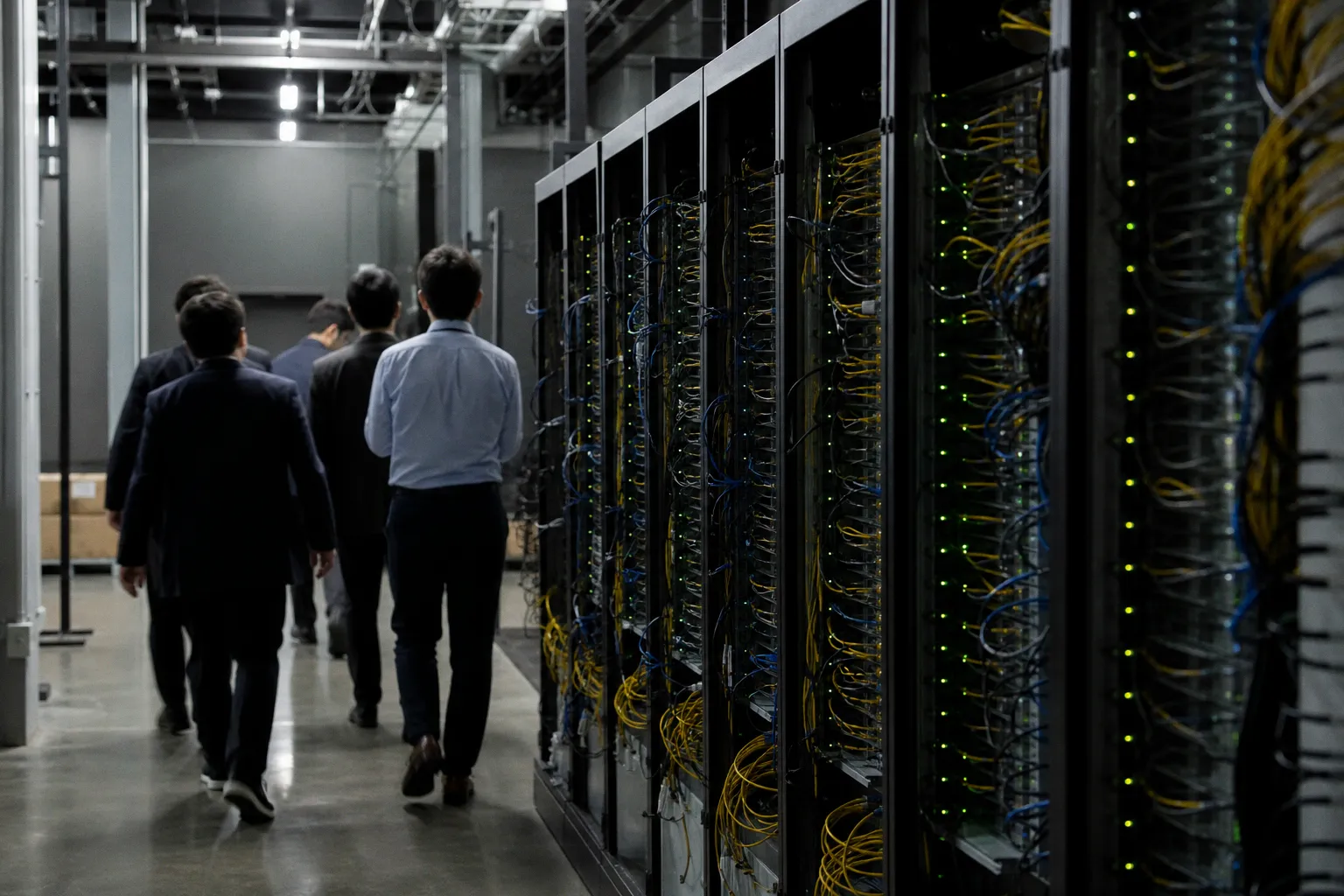
According to the Financial Times, South Korea’s cash-rich winners of the AI boom are pursuing a buying spree in the United States, a signal that the country’s AI capital cycle is beginning to extend beyond domestic fabrication, memory and data-centre commitments. The more concrete infrastructure marker comes from Nvidia and SK Group: Tom’s Hardware reports that the companies have signed letters of intent for a $500bn collaboration covering a 2GW AI data centre in South Korea and long-term HBM4 supply.
A capital stack moving beyond the rack
The Financial Times report provides no deal-by-deal disclosure in the available material, so the immediate point is directional rather than transactional: South Korean AI winners are being framed as active US buyers. For infrastructure investors and operators, that matters because the AI supply chain is not being financed solely through accelerator procurement.
SK Group’s proposed collaboration with Nvidia places compute capacity and memory availability in the same capital programme. A 2GW data-centre plan is not a marginal capacity addition; it makes the power envelope itself a central constraint alongside accelerators, networking and memory. The reported long-term HBM4 supply component further indicates that access to a named high-bandwidth memory generation is being treated as a strategic input rather than a spot-market purchase.
Letters of intent are not deployed capacity
The announced $500bn figure should be read with the legal and operational qualifier attached to it: Nvidia and SK Group have signed letters of intent. The available report does not specify an implementation timetable, allocation between the data centre and memory arrangements, installed accelerator count, model of Nvidia hardware, or expected FLOPs.
Those omissions are material. A nominal partnership value does not reveal usable training capacity, inference latency, memory bandwidth per node or the power-delivery architecture required to turn a 2GW target into operating clusters. Nor does a long-term HBM4 supply commitment disclose volumes, packaging capacity or delivery sequencing. The relevant question for the market is therefore not simply whether the headline number holds, but which portions become contracted, built and energised.
What to monitor next
The next disclosures worth tracking are narrow: US acquisition targets, terms attached to the letters of intent, and any technical description of the Korean data-centre deployment. Evidence of committed power, accelerator configuration and HBM4 volumes would convert the announcement from a strategic outline into a capacity forecast.
There is a useful distinction between a compact product redesign such as a slimmed-down weighted vest for runners and this kind of infrastructure programme: in AI, the weight is increasingly carried by power availability, memory supply and the ability to finance both over long deployment cycles. For developers, that makes supplier commitments and datacentre execution at least as consequential as the next parameter-count headline.