Nvidia Partners with Japanese Firms to Scale Cosmos Physical AI
According to StreetInsider, Nvidia is pairing a broad physical-AI coalition push with a much smaller deployment target: Cosmos 3 Edge, a 4-billion-parameter model for on-device vision reasoning.
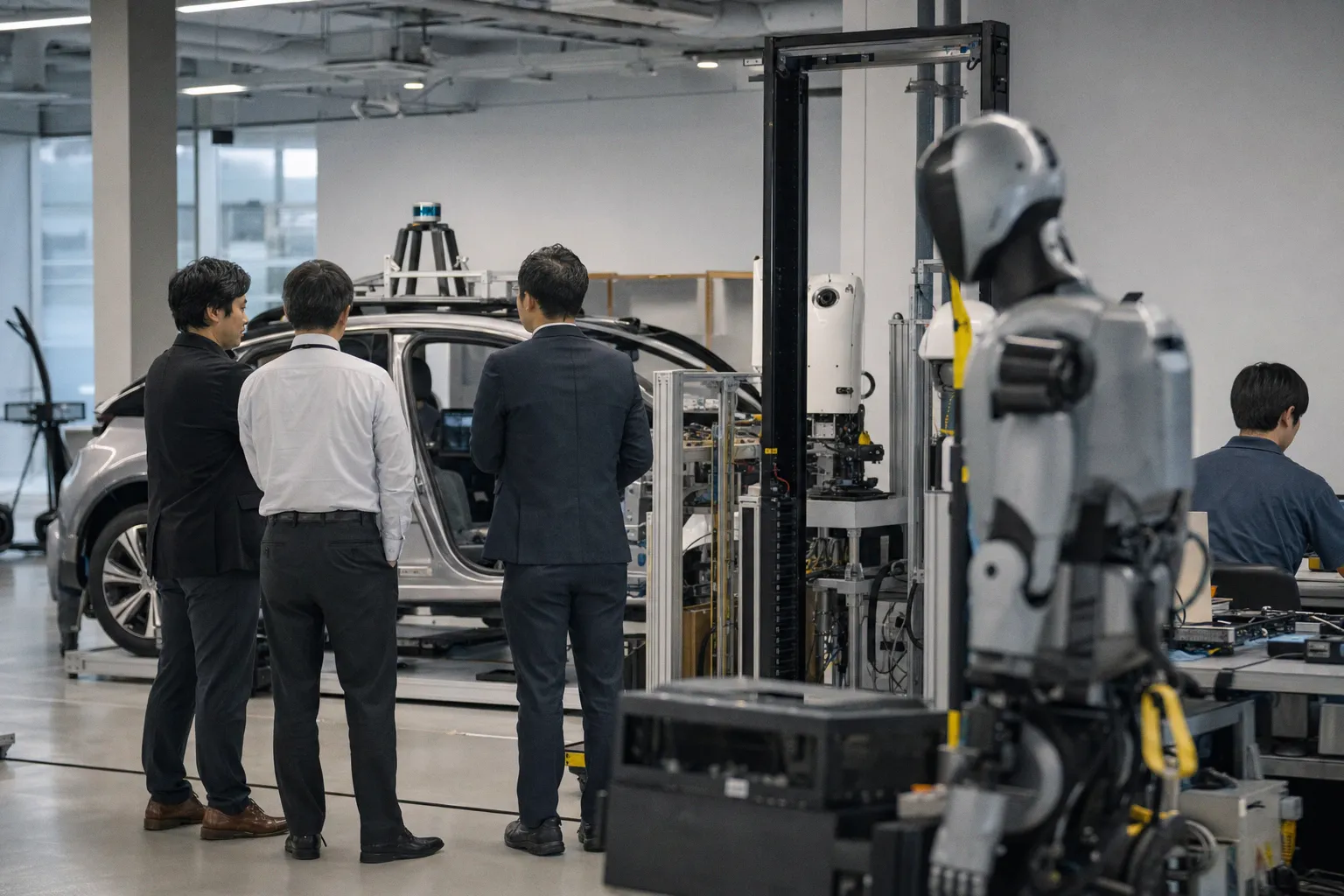
The marketing promise is “open physical AI”; the immediate product question is less abstract — can teams run useful visual reasoning where the camera and the decision actually sit?
A group of Japanese companies intends to join Nvidia’s Cosmos Coalition to advance open physical-AI models, the report said. For product teams building systems that must interpret the physical world, that makes the coalition’s membership more than a logo-wall update: it is a signal that Nvidia is trying to turn Cosmos into a shared layer for industrial AI development.
The edge model is the operational detail
Cosmos 3 Edge is designed for on-device vision reasoning and has 4 billion parameters, according to the report. That specification is the part worth watching first.
“On-device” changes the practical conversation. A vision system no longer has to be framed solely as a model endpoint somewhere behind a network connection; the intended use case puts reasoning closer to the camera or other local hardware. For developers, that shifts the stress test from model capability in isolation to deployment friction: how cleanly the model fits into an existing vision pipeline, what the latency looks like in a real workflow, and whether the UI wrapper gives operators an intelligible result rather than a black-box alert.
None of those implementation details were disclosed in the available report. That absence matters. A 4-billion-parameter model sounds deliberately more contained than the giant-model arms race, but parameter count is not an onboarding guide. Teams will need to look for concrete information on hardware requirements, supported environments, model access and evaluation tooling before treating Cosmos 3 Edge as a ready-to-ship component.
Japan gives the coalition a sharper industrial shape
The announced participation of Japanese companies is notable because physical AI is not a generic chatbot category. Its value depends on models meeting equipment, cameras, workflows and local operating constraints. New industrial participants could make the coalition more relevant to organisations looking for an open-model path rather than a one-vendor AI stack.
But “intend to join” is not the same thing as a deployed system, a commercial integration or a published benchmark. For buyers and engineering leads, the useful follow-up is specific: which companies join, what they contribute to the open physical-AI effort, and whether the resulting work produces reusable models or practical deployment paths.
What to track next
Nvidia has put two pieces on the board: a coalition intended to advance open physical-AI models and an edge-oriented vision-reasoning model. The strategic appeal is obvious — a shared model ecosystem paired with a component aimed at local deployment. The product verdict, for now, is not.
Cosmos 3 Edge is the item to watch if Nvidia can turn its platform narrative into a frictionless developer experience. Until technical access and deployment details emerge, the announcement is best read as a directional move: Nvidia is trying to bring physical AI closer to the device, while expanding the industrial network that could determine where its platform lands.