Compare liquid cooling needs for GB200 and B200 clusters
NVIDIA's Blackwell launch promised a clean generational leap: more performance, better efficiency, a straightforward upgrade path. Then the rack arrived.
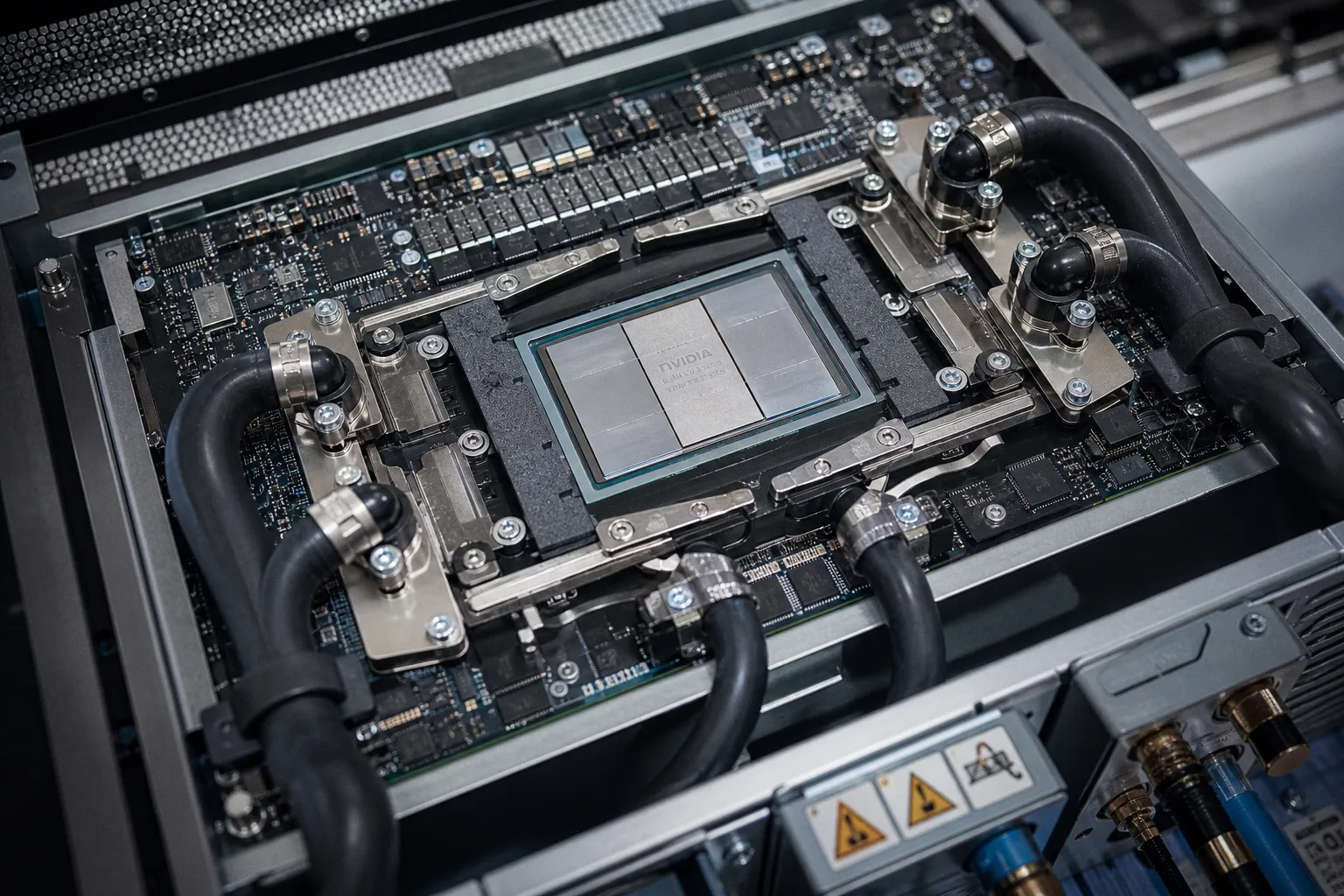
The Thermal Threshold Nobody Warned You About
I spent weeks digging into the actual thermal specifications, cooling infrastructure requirements, and retrofit economics of both configurations. The numbers tell a story NVIDIA's marketing slides glossed over — and if you're planning a cluster deployment in 2025 or 2026, this is the story that determines whether your budget survives contact with reality.
Where the B200 GPU Actually Lives on the Thermal Spectrum
Let's start with the part that sounds manageable. A single B200 GPU, dropped into an air-cooled HGX configuration, carries a Thermal Design Power of 1,000 watts. That's already a 40–70 percent increase over the H100 it replaces. Your existing 10-kilowatt racks won't handle it without significant airflow upgrades — but it's physically possible. Fans can move enough air across the heatsink to keep junction temperatures in check, provided your facility can supply the power and your raised floor (or overhead ducting) can evacuate the heat.
But "physically possible" and "peak performance" are two very different operating points. The B200 is engineered to hit 1,200 watts when liquid-cooled. That extra 200 watts isn't a vanity number — it's the thermal headroom that unlocks sustained boost clocks, higher memory bandwidth utilization, and the kind of consistent throughput that matters when you're running training jobs that span days. Air-cool it, and you're leaving performance on the table. You bought a sports car and you're driving it in second gear because the engine overheats in third.
Air-cooling a B200 GPU is like throttling a jet engine to fit inside a propeller hangar. Technically possible. Practically wasteful.
The onboarding experience for B200 in air-cooled infrastructure is, frankly, more forgiving than NVIDIA's hyperscaler-focused messaging suggests. If you're running a modest inference cluster — eight B200s in an HGX node, say — the thermal management challenge is real but solvable with conventional rack-level air handling. You'll need upgraded CRAC units, tighter hot-aisle containment, and a power delivery infrastructure that can sustain 8–10 kW per GPU slot. Painful, but not transformative.
The calculus changes the moment you scale.
GB200 NVL72: 132 Kilowatts in a Phone Booth
The GB200 NVL72 is not a bigger version of the B200 HGX. It's a fundamentally different thermal proposition. The rack-scale system — 72 Blackwell GPUs paired with 36 Grace CPUs, interconnected via NVLink in a single 21U to 42U enclosure — draws a nominal 132 kilowatts of Thermal Design Power. That's not a peak figure. That's the baseline.
Read that number again. One hundred and thirty-two kilowatts, concentrated in a volume that a decade ago housed maybe 15 kW of compute. Air cooling doesn't just struggle here. It fails entirely. The physics don't work. You cannot move enough air through a 21U chassis to evacuate 132 kW of heat without creating a wind tunnel that would make the rack mechanically unstable and acoustically uninhabitable for any technician standing nearby.
Direct liquid cooling isn't an optimization for the GB200 NVL72. It's a hard architectural requirement. Cold plates sit directly on every GPU and CPU die, carrying heat away through a closed-loop fluid circuit to a facility-side cooling distribution unit. No liquid, no boot. The system won't pass thermal throttling checks without it.
| Parameter | B200 HGX (Air-Cooled) | B200 HGX (Liquid-Cooled) | GB200 NVL72 (Liquid Only) |
|---|---|---|---|
| Per-GPU TDP | 1,000W | 1,200W | ~1,833W (132kW ÷ 72) |
| Rack TDP | ~8–10 kW (8-GPU node) | ~10–12 kW (8-GPU node) | 120–132 kW (full rack) |
| Cooling Method | Air (fans + heatsinks) | Direct-to-chip liquid | Direct-to-chip liquid (mandatory) |
| Performance Ceiling | Throttled | Full spec | Full rack-scale spec |
| Coolant Flow Rate | N/A | ~2–3 LPM per module | 700+ LPM total rack flow |
| Facility Impact | CRAC upgrade | CDU installation | Full plumbing overhaul |
The jump from "upgrade your air handlers" to "install industrial-grade liquid cooling infrastructure" is the real story of Blackwell's thermal profile. It's not a generation-over-generation tweak. It's an onboarding wall.
Heat Flux That Belongs in a Reactor, Not a Server Room
Here's the number that made me stop and re-read the spec sheet three times. A single GB200 Superchip — one Grace CPU mated to two B200 GPUs — generates a peak heat flux density of 500 to 600 watts per square centimeter. For context, that's comparable to the surface heat flux of a nuclear reactor fuel rod.
This isn't a metaphor. It's a thermal engineering constraint that dictates everything downstream: the cold plate design, the thermal interface material, the coolant flow rate, the junction-to-coolant thermal resistance target of 0.03°C per watt or less. Miss any of these parameters, and you're not looking at a performance penalty. You're looking at silicon degradation, electromigration failures, and a warranty claim conversation nobody wants to have.
The cold plate itself has to handle a maximum flow resistance of just 20 kilopascals. Push beyond that, and your pumping infrastructure scales nonlinearly — more power consumed by coolant pumps, more vibration transmitted through fluid lines, more stress on the blind-mate connectors that let you slide a compute tray in and out without draining the entire loop. These connectors have to seal reliably, thousands of times, under the vibration profile of a rack running at full tilt. The long-term reliability data for this specific use case — high-density blind-mate liquid connectors in high-vibration server environments over five-plus years — simply doesn't exist yet at scale. We're building the plane while flying it.
The GB200 Superchip's heat flux matches nuclear reactor fuel rods. Your data center wasn't designed for this. Neither was your budget.
The coolant itself needs to arrive at the cold plate inlet below 30°C to 45°C, depending on cold plate efficiency. That's a facility water supply requirement that most edge colocations and enterprise server rooms weren't spec'd for. If your building's chilled water loop runs at 45°C — common in temperate climates where free-cooling economizers are used — you're at the razor edge of the operating envelope. Anything warmer, and thermal throttling kicks in immediately.
Fluid Dynamics at Data Center Scale
Let's talk about the plumbing, because this is where the GB200 NVL72 deployment stops being an IT project and starts being a facilities engineering challenge.
Each GB200 module requires approximately 2 to 3 liters per minute of coolant flow. Scale that across 72 GPUs and 36 CPUs in a single rack, and you're looking at a total rack-level flow requirement exceeding 700 liters per minute. That's roughly 185 gallons per minute, circulating through micro-channel cold plates with tolerances measured in fractions of a millimeter.
Your cooling distribution unit — the CDU, the intermediary between the rack loop and the facility water — has to maintain that flow rate continuously, with redundancy. A CDU failure at 700+ LPM doesn't just slow down a training job. It triggers an emergency thermal shutdown across the entire rack in seconds. The thermal mass of the cold plates buys you maybe 30 to 60 seconds before junction temperatures spike into damage territory. Failover CDUs aren't optional. They're survival infrastructure.
Compare this to the B200 HGX in liquid-cooled configuration. Same fundamental technology — direct-to-chip cold plates, CDU-mediated heat exchange — but at a fraction of the scale. An 8-GPU HGX node needs perhaps 16 to 24 LPM. Manageable. Retrofittable. The kind of liquid cooling deployment that mid-size data centers have been doing for years with direct-to-chip solutions for dense GPU nodes.
The GB200 NVL72 demands facility-grade liquid infrastructure from day one. And that's where the economics get brutal.
The CapEx Wall: Retrofitting Air-Cooled Facilities
Here's where I stop being an observer and start being an advocate for honest cost disclosure. NVIDIA doesn't publish retrofit pricing for turning an air-cooled data center into a liquid-cooled one. But the industry data points converge on a consistent range: $5 to $10 million per megawatt of compute capacity, depending on whether you're doing a greenfield installation or retrofitting an existing facility.
Let that sink in. A single GB200 NVL72 rack draws 132 kW. Deploy ten racks — a modest training cluster — and you're at 1.32 megawatts of compute load. The cooling infrastructure to support that cluster could cost $6.6 to $13.2 million on top of the hardware itself. And that's before you account for the increased water consumption, the CDU footprint, the piping runs, and the floor reinforcement needed to handle racks that weigh up to 3,000 kilograms fully loaded.
| Cost Factor | B200 HGX (Air) | B200 HGX (Liquid) | GB200 NVL72 (Liquid) |
|---|---|---|---|
| Cooling CapEx | ~$50–100K (air handler upgrade) | ~$200–500K (CDU + piping) | $5–10M per MW (full retrofit) |
| Per-Rack Weight | ~800–1,200 kg | ~900–1,300 kg | ~3,000 kg |
| Water Dependency | None (closed air loop) | Moderate (CDU heat rejection) | High (700+ LPM per rack) |
| Failure Mode | Thermal throttle | Graceful shutdown | Emergency halt in <60s |
| Onboarding Complexity | Low | Medium | Facilities-grade engineering |
The air-cooled B200 HGX path keeps you in familiar territory. You're upgrading cooling capacity, not reinventing it. The GB200 NVL72 path requires you to fundamentally rethink your facility — and that rethink carries a price tag that often exceeds the cost of the compute hardware itself.
This is the gap the digital services and infrastructure planning tools space has been slow to address. TCO calculators from vendors rarely surface the cooling infrastructure delta between air-cooled and liquid-cooled deployments. They show you the GPU price, the networking cost, maybe a line item for power distribution. The $5–10M per megawatt cooling retrofit? Buried in a footnote, if it appears at all.
So Which Path Actually Makes Sense?
Let me be direct, because this is where opinionated analysis beats diplomatic hedging.
If you're running inference workloads at moderate scale — eight to 64 GPUs, serving models that don't require rack-scale NVLink bandwidth — the B200 HGX in an air-cooled configuration is the pragmatic choice. You get meaningful performance gains over H100, you avoid the liquid cooling infrastructure investment, and your existing facility can handle the thermal load with reasonable upgrades. Liquid-cooling the B200 HGX unlocks that extra 200 watts per GPU, and if your colocation already has CDU infrastructure, it's worth doing. But it's not mandatory.
If you're deploying training infrastructure at scale — the kind of cluster that trains foundation models, that needs 72-GPU NVLink domains for tensor parallelism — the GB200 NVL72 is the only game in town. And liquid cooling isn't a feature. It's the price of admission. Budget for it from day one. Don't let your facilities team discover the 700 LPM rack flow requirement after the hardware purchase order has been signed.
The thermal engineering challenge of Blackwell isn't a footnote to the compute story. It's the gating factor. The GPUs will ship. The question is whether your data center can absorb them.