AI Data Center Water Usage: Air vs. Liquid Cooling
The liquid-cooling market was worth $5.52 billion in 2025 and is projected to reach $15.75 billion by 2030. That 23.31% annual growth rate is not a climate-tech slogan.
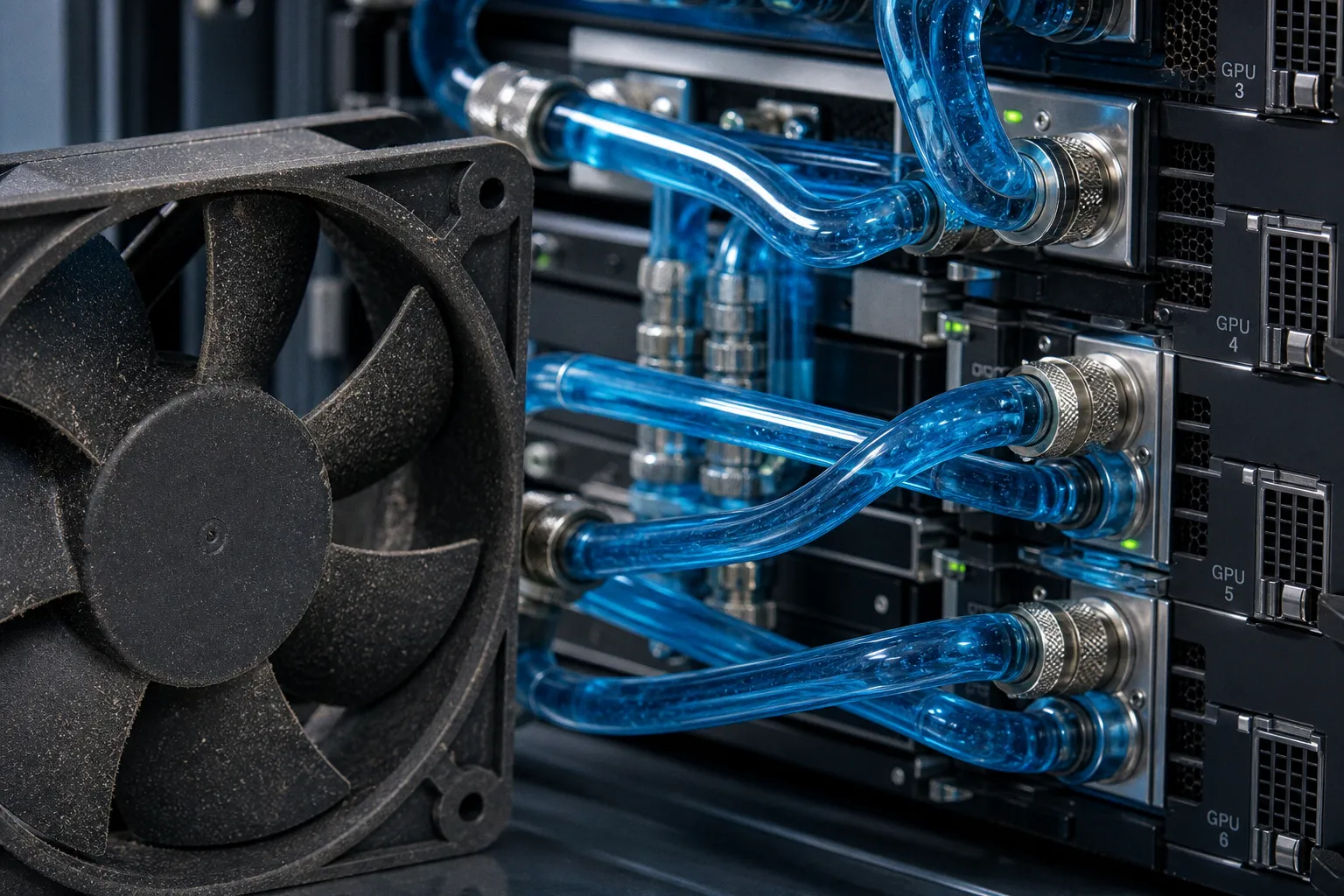
The hard constraint sits at roughly 41.3 kW per rack. Above that level, traditional air cooling starts to lose its physical argument. Modern AI clusters do not negotiate with thermodynamics. A rack packed with high-end accelerators can push beyond 200 kW. At that density, moving more chilled air is not infrastructure strategy. It is an increasingly expensive attempt to preserve a legacy layout.
The AI data center water usage debate is often framed as a choice between thirsty cooling towers and water-free alternatives. That is too neat. Air cooling can consume virtually no water on site when it relies on mechanical refrigeration. Evaporative air cooling can consume a great deal. Closed-loop liquid systems can sharply reduce water consumption, but they do not make water disappear from the equation. The distinction matters because developers, utilities and investors are now pricing physical constraints rather than presentation decks.
Air Cooling Hits a Density Wall
Air remains a sensible cooling medium for conventional enterprise workloads. At rack densities below roughly 15–20 kW, it is familiar, serviceable and relatively cheap to deploy. The installed base is enormous. The supply chain is known. Facilities teams understand the failure modes.
AI changes the arithmetic.
A GPU cluster concentrates heat in a far smaller footprint than the server fleets that shaped the conventional data center. The computational value of each square foot rises. So does the thermal load. Fans can move only so much heat before airflow volumes, pressure differentials and power draw become punitive.
At around 41.3 kW per rack, air cooling reaches its practical physical limit. There are ways to stretch the threshold: hotter supply air, larger containment systems, rear-door heat exchangers, more aggressive fan curves and lower-density rack design. Each is a compromise. Each costs money. And spreading the same GPU load across more racks means paying for more floor space, more power distribution, more networking and more building shell.
Liquid cooling can support rack densities above 200 kW because liquid transfers heat far more efficiently than air. That does not mean every AI rack will immediately move to immersion tanks or direct-to-chip cold plates. It means the economic center of gravity has moved.
| Parameter | Traditional air cooling | Liquid cooling |
|---|---|---|
| Practical rack-density range | Becomes constrained around 41.3 kW per rack | Can support more than 200 kW per rack |
| Cooling overhead per kW of IT load | 0.5–1.2 kW | 0.1–0.3 kW |
| Water profile | Can be near-zero on site with mechanical cooling; high consumption with evaporative towers | Lower consumption in closed-loop and immersion designs, but not zero |
| Facility implication | More floor area and airflow infrastructure at high densities | Higher upfront integration cost; tighter thermal envelope |
| Best fit | Standard enterprise and lower-density compute | Dense AI and HPC deployments |
The key financial point is uncomfortable for operators hoping to defer capital expenditure: air cooling does not become cheaper merely because it is already installed. At AI-scale densities, it can turn into a tax on every additional megawatt.
The cooling decision is no longer a facilities detail. It determines how much usable AI compute a building can monetize per square foot.
The Water Bill Depends on What “Water Usage” Means
Data center water consumption is routinely reported without enough context to be useful. The industry uses Water Usage Effectiveness, or WUE, typically expressed as liters of water evaporated per kilowatt-hour of IT energy. The broad industry average is approximately 1.8 liters per kWh, though actual performance ranges from 1 to 9 liters depending on climate, cooling design and operational choices.
That range is not statistical noise. It is the business model of local infrastructure risk.
A facility in a hot, dry region using evaporative cooling may post a much larger water footprint than a cooler-climate site with a different heat-rejection design. A cloud provider can report an annual efficiency metric that looks acceptable while creating acute seasonal demand precisely when surrounding communities have the least spare water.
The most persistent confusion is between water withdrawal and water consumption:
- Withdrawal is water taken from a local source, whether a utility, river, aquifer or other supply.
- Consumption is water that does not return to the local system in usable form, most often because it evaporates.
- Discharge is water returned as wastewater, sometimes after treatment and often with restrictions on temperature or chemical content.
Evaporative cooling towers are effective because evaporation carries heat away. The same mechanism is why they can be water-intensive. Water is not simply circulating through the facility. A material portion leaves as vapor.
Air-cooled systems, by contrast, can consume virtually zero water on site. That point deserves to survive the current liquid-cooling rush. A chiller-based, air-cooled design may draw more electricity but use little or no on-site water. The trade-off is not “air equals water waste, liquid equals water savings.” It is a three-way balance between energy, water and capital cost.
For an AI operator, the question is therefore more specific: which cooling architecture produces the lowest total operating exposure in this geography, at this rack density, under this power contract and water regime?
The answer changes by site. That is why broad claims about “sustainable cooling” are usually a warning sign. The operating model sits in the details.
Evaporative Versus Closed-Loop Cooling: Where the Water Goes
Evaporative cooling and closed-loop liquid cooling are often placed on opposite sides of the water debate. The technical distinction is real, but the accounting needs discipline.
In a traditional evaporative system, water absorbs heat and part of it evaporates. That evaporation is the cooling process. Makeup water must replace what leaves the system, while additional water may be discharged as blowdown to control mineral concentration.
Closed-loop liquid cooling circulates a coolant through a contained circuit. It does not intentionally evaporate water as part of the primary loop. Research figures indicate that closed-loop systems consume roughly 5% to 10% of their water withdrawal, returning 90% to 95% as wastewater. There can still be leaks, maintenance losses and water use at the heat-rejection stage. “Closed loop” is not the same as “zero-water.”
Immersion cooling goes further by placing components in a dielectric liquid that carries heat away from the hardware. Compared with traditional evaporative cooling towers, immersion systems can reduce water consumption by 95% to 98%. At a 10 MW facility, that can translate into annual savings of roughly 18 million to 45 million gallons.
The range is wide because the baseline matters. So do climate, load factor and the rest of the heat-rejection chain. A vendor can correctly advertise a 98% reduction against a water-heavy evaporative baseline while avoiding the inconvenient fact that an air-cooled facility may already consume almost no on-site water. Both statements can be true. Neither settles procurement.
Direct-to-chip: the current compromise
For many AI data centers, direct-to-chip cooling is the practical middle route. Cold plates attach to the hottest components—typically GPUs and CPUs—while a controlled liquid loop removes the bulk of the thermal load. Air may still cool memory, storage, networking equipment and residual heat.
This hybrid model has advantages:
1. It targets the expensive heat source. The accelerators generating the densest thermal load receive liquid cooling without requiring every component to be submerged.
2. It preserves some familiar data center operations. Operators can retain parts of conventional rack and aisle design rather than rebuild the entire maintenance model.
3. It improves power economics. Cooling overhead can fall to 0.1–0.3 kW per kW of IT load, versus 0.5–1.2 kW for typical air-cooled implementations.
4. It protects density. The operator can deploy more compute in the same building shell, which matters when utility interconnection and permitted land are scarcer than capital.
5. It creates new dependency points. Manifolds, quick-disconnect fittings, coolant distribution units and leak detection become critical infrastructure. The cap table may celebrate GPU procurement; the uptime risk often sits in the plumbing.
That final point is not trivial. Liquid cooling shifts complexity rather than abolishing it. Air systems have fans, filters, chillers and containment problems. Liquid systems add fluid quality management, pressure control, connector reliability and service procedures that many legacy teams have not practiced at scale.
A lower liquid cooling water footprint is valuable. It is not a substitute for designing the heat-rejection system, maintenance model and outage plan properly.
Energy Savings Are the More Immediate Margin Story
Water is politically visible. Electricity is usually more expensive.
A cooling system consuming 0.5–1.2 kW for every kW of IT load imposes a significant overhead on a data center’s power budget. Liquid cooling can reduce that to 0.1–0.3 kW per kW of IT load. The gap is not merely an environmental metric. It changes the amount of revenue-generating compute that can sit behind a fixed utility connection.
Consider the logic, without pretending every facility has the same tariff. If a site has a finite power allocation, every megawatt consumed by cooling is a megawatt unavailable to GPUs. In a capacity-constrained AI market, that is a direct hit to sellable compute inventory. The operator either accepts lower utilization, upgrades the power infrastructure, or pays a premium for additional capacity if it can obtain it at all.
This is why the liquid-cooling market’s growth projection deserves attention. The move from $5.52 billion in 2025 to $15.75 billion in 2030 is not simply hardware vendors finding a new acronym to sell. It reflects a transfer of spending from general-purpose facility equipment to high-density thermal management.
The winners are not automatically the companies with the most dramatic immersion demonstrations. The durable economics will favor suppliers that can lower total cost of ownership across several line items:
- cooling energy overhead;
- water procurement and wastewater handling;
- data hall floor area;
- rack-level power density;
- deployment speed;
- maintenance labor and spares;
- and, most importantly, downtime risk.
A 200 kW rack that cannot be serviced safely is not an infrastructure asset. It is a concentrated operational liability.
The valuation question follows from there. Cooling companies are being repriced as picks-and-shovels beneficiaries of AI capital expenditure. Some will justify higher revenue multiples because their products are designed into new facilities and difficult to replace. Others will discover that being adjacent to GPU demand does not create pricing power. Commodity heat exchangers and bespoke integration work do not automatically produce software-like margins. The burn rate of a hardware supplier remains stubbornly physical: inventory, qualification cycles, manufacturing capacity and field support all require cash before recurring revenue arrives.
Water Risk Is Local, Not Global
The phrase “AI data center water usage” invites global totals. Those totals are useful for headlines and weak for decisions.
The relevant question for a developer is local: how much water will this facility consume during the hottest hours of the hottest season, and who else needs that water? A 10 MW data center can be a modest load in one region and a politically explosive one in another. The same applies to wastewater capacity, water-quality rules and drought restrictions.
For investors, that turns water into a permitting and liquidity issue. A project can have contracted land, secured servers and announced power capacity, yet still face delays if local water arrangements become contested. Those delays matter because GPU hardware depreciates economically from the day it is delivered. A cluster sitting idle while a cooling design is revised is not waiting patiently. It is burning capital.
Liquid and immersion approaches can reduce that exposure substantially compared with evaporative cooling. The estimated 18 million to 45 million gallons of annual savings for a 10 MW facility is material. But a lower water footprint does not remove the need to examine the full system boundary.
Questions that distinguish a credible infrastructure plan from marketing copy include:
- Is the water figure measured as withdrawal, consumption or both?
- Does the cooling loop rely on evaporative heat rejection elsewhere in the chain?
- What happens to water during peak ambient temperatures?
- How much water is discharged, and under what treatment requirements?
- Is the projected rack density actually required by the deployed accelerator configuration?
- Does the site have a realistic maintenance protocol for liquid distribution hardware?
- What is the cost of redundancy when pumps, coolant distribution units or connections fail?
These are not compliance footnotes. They determine whether the promised PUE-like efficiency gains become operating margin or merely migrate into another budget line.
The Retrofit Problem Will Separate Buyers From Builders
Greenfield AI campuses can be designed around liquid cooling from the start. Pipe routing, floor loading, coolant distribution, electrical architecture and service access can be planned as one system. The economics are cleaner, even if upfront capital expenditure is higher.
Retrofitting an existing air-cooled data center is a more difficult exercise. The building may lack the power distribution, ceiling height, piping routes, floor strength or maintenance space needed for dense liquid-cooled racks. A partial retrofit can work, especially with direct-to-chip systems, but it can create a two-tier operating model: conventional air-cooled equipment in one area, dense AI infrastructure in another.
That split is manageable. It is not free.
Operators must also avoid a familiar AI-infrastructure error: buying for the peak presentation rather than the actual deployment schedule. A facility engineered for 200 kW racks makes sense when the GPU roadmap, customer contracts and power allocation support it. It makes less sense when the near-term load sits far below that threshold and the cooling plant is financed against speculative utilization.
This is where capital discipline returns. The AI infrastructure cycle has encouraged large announcements because large numbers attract attention. But cooling equipment has no secondary market with deep liquidity when a project is delayed. The useful asset is the one matched to a contracted load, not the one that produced the most impressive rendering.
Liquid Cooling Is Becoming the AI Default—Not the Universal One
Liquid cooling is increasingly the rational choice for dense AI compute. The thermal math is decisive above the limits of air. Its energy overhead is lower. Its water consumption can be dramatically lower than evaporative cooling, particularly with immersion systems. And its ability to support more than 200 kW per rack gives AI operators a route to monetize constrained power and real estate more efficiently.
But the cleanest conclusion is not that air cooling is obsolete. It is that air cooling has been demoted from default architecture to workload-specific option. For standard enterprise compute below 15–20 kW per rack, it can remain economically sound and operationally simple. For high-density GPU clusters, it becomes a costly way to avoid changing the plumbing.
The market will spend toward $15.75 billion by 2030 because there is no cheap alternative to removing heat from dense compute. Water savings will help make the case, especially in stressed regions. Energy economics will often close it.
The sober reality is that liquid cooling does not rescue a weak data center thesis. It cannot create power capacity, solve permitting disputes, repair an overleveraged project or guarantee GPU utilization. It does something more prosaic—and more valuable. It lets a credible AI facility operate at the densities the hardware now demands.